Sometimes You Just Have to Bite the Bullet
Y
yeethernal
Jul 11, 2026 · EN
55
9
3
Gold earned
0.0064 gold · 0.0001 from the game fund for every read and every like
Every city reaches a point where small adjustments are no longer enough.
For a long time, I believed I could keep expanding my town by simply finding empty spaces for new buildings. Whenever I unlocked a new structure, I looked for the nearest available plot, connected it with roads, and moved on. It worked well in the early stages, and watching the city grow organically was satisfying. Every neighborhood seemed to have its own identity, and I rarely questioned whether my decisions would become a problem later.
Eventually, however, those early choices began to catch up with me.
As I unlocked higher-level buildings, I realized that placement mattered far more than I had anticipated. A Market wasn't just another building—it needed to be close to the structures that depended on it. The Firehall wasn't effective if it sat on the opposite side of town from the buildings requiring its coverage. The Police Station faced the same issue, and every new requirement made my city feel increasingly tangled.
Instead of one well-planned town, I had unintentionally created a collection of disconnected districts that had simply grown wherever there happened to be room.
Like many players, my first instinct was to avoid drastic measures.
I searched for tiny improvements. Maybe I could move one building. Maybe a new road would solve the problem. Maybe I could squeeze a Firehall into an awkward corner and somehow make everything work. Every solution was designed to preserve what I had already built.
The truth was that I wasn't protecting my city—I was protecting the time I had already invested in it.
Eventually I had to admit something I didn't want to hear: the layout itself was the problem.
That realization led me to do something I had been avoiding for days.
I bit the bullet.
I demolished entire blocks of my city.
Watching buildings disappear after spending so much time constructing them felt wrong. Resources had been invested. Roads had been carefully connected. Neighborhoods had existed for a long time. Destroying them almost felt like throwing progress away.
But once the empty space appeared, something unexpected happened.
Instead of seeing loss, I saw possibilities.
For the first time since starting the town, I wasn't trying to force new buildings into an outdated design. I could actually plan.
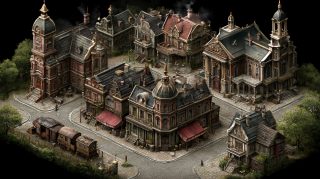
Rather than making every area serve every purpose, I divided the city into specialized districts. Buildings with similar requirements were placed together. Markets were positioned where they could support the greatest number of nearby structures. Firehalls and Police Stations were no longer afterthoughts—they became central pieces around which entire neighborhoods were organized.
The city immediately became easier to understand.
More importantly, it became easier to expand.
Every new building now had a logical place instead of forcing me to ask, "Where can I squeeze this in?" Future upgrades became part of the plan instead of obstacles that required another compromise.
Looking back, I realized that my biggest mistake wasn't poor planning when I first built the city. That's normal. At the beginning of the game, you simply don't know what future requirements will look like. The mistake was believing I had to preserve every early decision forever.
Sometimes we become attached to layouts simply because we've spent a lot of time building them. We convince ourselves that rebuilding is wasteful because we've already invested resources and effort. In reality, refusing to rebuild can cost even more in the long run.
That lesson extends beyond city-building games. Whether it's organizing a base, designing software, or even arranging a workspace, there comes a moment when patching old decisions stops being productive. Continuing to work around outdated choices only creates more complexity.
Sometimes the fastest path forward is to step backward first.
So if your town is starting to feel crowded, inefficient, or impossible to expand, don't be afraid to ask yourself a difficult question: are you solving today's problems, or are you preserving yesterday's mistakes?
Demolishing part of my city wasn't the most enjoyable thing I've done in the game, but it was probably one of the best decisions I've made. The rebuilt district is cleaner, more efficient, and far better prepared for future upgrades.
Sometimes, you really do just have to bite the bullet.