I Built First and Understood Later
P

player5446
Jul 27, 2026 · EN
29
4
6
Earned
135.99 HUF · the local value of 0.0001 gold from the author's country treasury for every read and every like
When I first opened my town in CoinRepublik, I did not see a city planning puzzle. I saw a collection of buildings, some roads, a few empty or covered plots, and many buttons that I did not yet understand. My first instinct was simple: if the game allows me to build something, then building it must be progress.
That assumption has already caused me a few problems.
My starting town was partly developed when I arrived. Some production buildings were grouped together on one plot, while most of the houses occupied another area. This was helpful because I did not have to begin with completely empty land. At the same time, it meant that many of the useful central spaces were already occupied before I understood why their locations might matter.
During the practical tutorial, I was asked to build a marketplace. The game selected a location near the edge of my town, so I followed the instructions and built it there. At that point, I believed the important thing was simply to own a marketplace. I did not yet understand that service buildings have an area of influence and that their position can be more important than their existence.
Later, I enthusiastically built another marketplace and a police station. Once again, I placed them near the edge of the map, where I had available space. It seemed reasonable at the time. Empty land looked like an invitation to expand, and I wanted to see new buildings appear in my town.
Unfortunately, a marketplace at the edge of an undeveloped area does not help very much. One of mine currently covers little more than a single house. The police station has a similar problem. They may become useful one day if I expand the town around them, but for now they are service buildings waiting for a neighbourhood that does not exist.
The problem became obvious when I tried to upgrade my City Hall. One of the requirements was to have a marketplace within its area of influence. I already had marketplaces, so I expected this condition to be satisfied. It was not. The buildings looked close enough on the map, but apparently “close enough” to my eyes and “within range” to the game are two different things.
This left me wondering how the influence system worked. Did diagonal placement count? Was the distance measured from the centre of the building, its entrance, or the road? Did the road connection change the range? I looked at the map and could not see any obvious circles, coloured tiles, or other visual information.
For some time, I was convinced that the game simply did not display building coverage. This bothered me because clearing land, constructing roads, and putting up a new building all require resources, energy, and time. Building in the wrong place is not a harmless experiment.
Then I discovered the answer almost by accident.
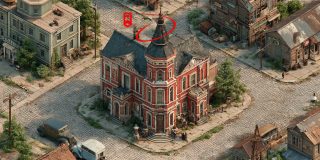
When I moved the mouse cursor over the marketplace, part of the map changed colour. The shaded area showed the building’s influence. The information had been available all along; I simply did not know how to reveal it.
It was a useful discovery, but also a slightly embarrassing one. I had spent a fair amount of time wishing for a feature that was already there. On the other hand, I still think such an important tool could be easier to notice. A short message, a visible icon, or an optional coverage layer would help new players understand the map before they make permanent and expensive decisions.
Now I can finally see why my existing marketplaces do not meet the City Hall requirement. The map is no longer completely mysterious. Unfortunately, understanding the mistake does not automatically repair it.
There is very little free space between my residential area and my production buildings. To place a useful marketplace in the middle, I may eventually have to demolish something, reorganise part of the town, or develop a new area with additional roads. The marketplace itself may also require another supporting building nearby before it can be upgraded. Every solution creates a new requirement.
This is where CoinRepublik begins to feel less like a simple building game and more like actual city planning. A building is not only its construction cost or its production value. It also occupies a location, depends on roads, interacts with nearby services, and may limit future development. Empty space is therefore a resource too, even though it does not appear in the inventory.
I have not decided yet what I will do with my badly placed buildings. Perhaps I will eventually expand around them and turn those quiet edges into useful districts. Maybe upgrading them will improve their coverage, although I still need to confirm that before spending more resources. It is also possible that rebuilding part of the centre will become necessary later.
For now, I have learned to slow down before pressing the build button. I check the surrounding roads, look at the influence of nearby buildings, and try to imagine what else may need that space later. I certainly do not have a perfect city plan, but at least I now know that a free plot is not automatically the right plot.
My town still contains several decisions made by a beginner who was excited to build and did not yet understand the map. I cannot really complain about that beginner, because it was me only a few days ago. CoinRepublik continues to teach me in a very practical way: first I build something, then I discover why I should have thought about it more carefully.
Perhaps this is part of the experience. A perfectly planned town would be more efficient, but a slightly confused town tells a better story. Mine certainly has a story already.