How the mid-game quietly changes you
Y
yeethernal
Jul 12, 2026 · EN
85
22
4
Gold earned
0.0107 gold · 0.0001 from the game fund for every read and every like
I swear on my mustache, I thought the hardest part of CoinRepublik would be surviving the first few days. Learning how energy worked, figuring out production chains, placing buildings without wasting land—surely that was where the real challenge lived.
I couldn't have been more wrong.
The early game teaches you mechanics. The mid-game teaches you patience.
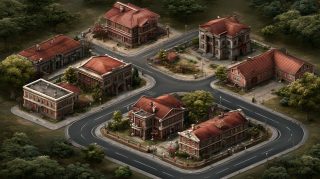
There's an odd moment that almost every player reaches, although many don't notice it immediately. Your town finally looks respectable. You have production running, roads connecting everything, workers doing their jobs, and enough resources that every decision no longer feels like life or death. From the outside, it looks like success.
Yet progress suddenly feels... slower.
At first, I wondered whether I had done something wrong. Buildings took longer to upgrade. Every expansion seemed to demand several other upgrades beforehand. New districts required more planning than construction itself. It almost felt as if the game had quietly started resisting me.
Then, after a few thoughtful strokes of my mustache, I realized something important.
The game hadn't changed.
I had.
During the early stages, every improvement is obvious. A single building doubles your production. One new road unlocks an entirely new area. Every action gives immediate satisfaction because your town is so small that every improvement is visible.
The mid-game doesn't reward visible progress anymore.
It rewards invisible decisions.
You stop asking, "What should I build next?"
Instead, you begin asking, "Should I build anything at all today?"
That is a completely different game.
Planning suddenly becomes more valuable than construction. Positioning matters more than expansion. A poorly placed building isn't just inconvenient anymore—it can become an expensive obstacle that survives for weeks before you finally decide to demolish it.
I learned that lesson the painful way after rebuilding entire districts that I had once been proud of.
Sometimes the fastest progress comes from admitting yesterday's plan wasn't good enough.
War changes your perspective as well.
Before the combat system arrived, I viewed military buildings as something distant—something future me would eventually worry about. Then the first conflicts began, and suddenly every academy, every defensive position, and every production chain feeding the military became part of the town's long-term planning.
Resources available at higher levels stopped feeling optional. They became part of a much larger picture.
The same happened with energy.
In the beginning, energy feels like a simple limitation. You spend it, you wait, you recover it.
Later, you begin seeing it differently.
Every unnecessary action becomes an opportunity cost. Demolishing buildings, rebuilding roads, correcting old mistakes—they all consume energy that could have been invested elsewhere. Good planning isn't simply about saving materials anymore. It is about protecting tomorrow's energy before tomorrow even arrives.
Politics quietly joins the picture too.
Early on, laws seem like something other players worry about. Then you begin paying attention to taxes, bonuses, state budgets, voting power, and treasury management. You realize that the country around your town influences your progress almost as much as your own decisions.
The game gradually stops being about a single mayor.
It becomes about an entire society.
Markets evolve in much the same way.
When you're new, selling products feels straightforward: produce something, list it, collect the money.
Eventually you notice pricing, competition, taxes, storage costs, transportation, and market positioning. Selling becomes less about making products and more about understanding people.
Patience becomes a competitive advantage.
Perhaps that is my favorite part of CoinRepublik.
The game never announces that you've entered the next stage.
There is no message saying, "Congratulations, you have reached the mid-game."
Instead, one day you simply catch yourself spending fifteen minutes thinking before placing a single building.
And somehow, those fifteen minutes save you days of rebuilding later.
Looking back, I don't think the mid-game is defined by bigger towns or stronger economies.
It is defined by a quieter change.
You stop chasing progress and start protecting it.
You stop solving today's problems and begin preventing next month's.
You become comfortable waiting because you finally understand that not every idle moment is wasted time.
Some of the best decisions I have made in CoinRepublik were the ones where I chose to do nothing for a day, gather a little more information, and think one step further ahead.
That patience rarely feels exciting in the moment.
But months later, when your town still functions efficiently while others are rebuilding the same streets for the third time, you begin to appreciate what the mid-game was really trying to teach you.
It was never about constructing larger cities.
It was about becoming a better mayor.
And if my old mustache has taught me anything over the years, it's that careful planning usually grows faster than hurried construction.