# Understanding the Marketplace: Building Wealth Through Smart Trading
P
Pibasacro
Jul 16, 2026 · EN
95
24
3
Gold earned
0.0119 gold · 0.0001 from the game fund for every read and every like
By the time you reach this stage of the game, your city has already taken its first important steps. You have established production, hired workers, and started generating resources. These achievements are the foundation of your economy, but they are only half of the story. A city that produces goods without trading them will eventually struggle to grow. Likewise, a city that relies only on buying resources without producing anything will never become truly prosperous. The Marketplace exists to connect these two sides of the economy, creating a continuous cycle of production, trade, and expansion.
For many new players, the Marketplace appears intimidating at first. There are numerous products, changing prices, and thousands of offers created by players from around the world. Fortunately, the basic principles are remarkably simple. Once you understand how the Marketplace works, it becomes one of the easiest and most rewarding parts of the game. Every purchase helps your industries continue operating, while every sale transforms your hard work into income that can be reinvested in future growth.
The most important idea to remember is that the Marketplace belongs to the players. It is not a shop operated by the game itself. Every resource, every finished product, every worker, and every share available for sale has been placed there by another player. Likewise, whenever you create a sell order, your goods become available for someone else to purchase. This simple concept creates an economy that is constantly evolving as thousands of players make decisions based on their own needs and strategies.
Because the economy is player-driven, prices are never completely fixed. They respond naturally to supply and demand. When many cities produce the same resource, competition usually pushes prices downward. When demand suddenly increases or production becomes limited, prices often rise. This means that the value of an item depends not only on what it is, but also on how many players need it at a particular moment. Watching these price movements gradually teaches you how the economy functions without requiring advanced financial knowledge.
The Marketplace gives every player an important advantage: flexibility. Imagine that one of your factories suddenly needs iron, but your city does not produce enough to keep production running. Without a Marketplace, you would have to build additional mines, hire more workers, and wait until production increased. Instead, you can simply purchase the missing iron from another player. Within moments, the resources are available in your warehouse, allowing production to continue without delay.
The opposite situation happens just as often. Perhaps your farms have produced far more grain than your citizens can consume. Rather than allowing valuable inventory to remain unused, you can sell the excess on the Marketplace. Another player who requires grain will purchase it, providing you with additional income while freeing warehouse space for future production. This constant exchange of shortages and surpluses allows cities of every size to develop efficiently.
One of the greatest strengths of the Marketplace is that it encourages specialization. No city is expected to produce every resource available in the game. In fact, attempting to do so often slows development by spreading investments across too many industries. Instead, successful players focus on production chains that suit their strategy while relying on the Marketplace to obtain everything else. A city specializing in agriculture may regularly purchase metals, while an industrial city may buy food from farming communities. Both cities benefit from cooperation through trade.
To keep the economy organized, the Marketplace is divided into four major categories. Understanding these categories makes navigation much easier, especially during your first days of trading.
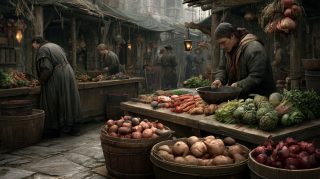
The first category is the **Raw Materials Market**. Here you will find the essential resources that begin every production chain. Wood, stone, clay, grain, agricultural products, metals, and gold ore are all traded in this section. Nearly every manufacturing process depends on these materials, making this one of the busiest markets in the game.
The second category is the **Consumer Goods Market**. Unlike raw materials, these products have already completed the production process and are intended for your citizens. Food, beverages, tobacco, clothing, and jewelry are common examples. As your population grows, these products become increasingly important for maintaining a healthy and prosperous city.
The third category is the **People Market**, where players exchange workers and specialists. Every production building requires labor, and expanding industries often create sudden labor shortages. Purchasing additional workers allows businesses to begin operating immediately, while selling surplus workers provides another opportunity to earn money.
The fourth category is the **Share Market**, where CoinRepublik shares are traded using GOLD. Instead of exchanging physical goods, players buy and sell investments. Although this market becomes more relevant as your experience grows, it represents another important aspect of the game's player-driven economy.
Although each market contains different products, they all operate according to the same principles. You select an item, examine the available offers, compare prices, and decide whether to buy immediately or create your own offer for sale. Once you understand this process, moving between different markets becomes effortless.
Comparing prices is one of the simplest ways to improve your trading efficiency. Several players often sell identical products, but not always at identical prices. Taking a few moments to compare offers before making a purchase can significantly reduce your expenses over time. Likewise, observing existing listings before selling helps you choose a competitive price that attracts buyers while maximizing your profit.
Many experienced players develop the habit of checking market prices before making important production decisions. Sometimes producing an item yourself is highly profitable. At other times, purchasing the finished product from another player may actually be cheaper than manufacturing it locally. Learning to recognize these opportunities allows you to allocate your resources more efficiently and expand your city more quickly.
As you continue trading, you will begin noticing patterns within the economy. Certain resources become more valuable when many players expand their industries simultaneously. Others become abundant when production increases across the server. These fluctuations create opportunities for attentive traders who monitor market conditions and adapt their strategies accordingly.
Fortunately, you do not need to predict every price movement to succeed. The Marketplace rewards consistency more than speculation. Buying resources at reasonable prices, selling surplus goods regularly, and avoiding unnecessary expenses are often more profitable than attempting to guess future market trends.
Another feature that makes the Marketplace especially convenient is automatic delivery. Every item you purchase is transferred directly into your city's shared warehouse. There is no transportation network to manage and no delivery delay to worry about. The resources become immediately available for your production buildings, allowing your industries to continue operating without interruption.
This shared warehouse also stores everything produced by your own businesses. Whether goods originate from your farms, factories, or another player's city, they all arrive in the same inventory. This unified storage system simplifies city management and eliminates unnecessary logistical complexity, allowing players to focus on strategy instead of transportation.
Perhaps the most reassuring aspect of the Marketplace is that learning happens naturally through experience. Your first trades do not need to be large or perfectly timed. Buying a small quantity of wood, selling excess grain, or comparing a few offers teaches valuable lessons about how the economy works. Every completed transaction increases your confidence and improves your understanding of market behavior.
Over time, trading becomes an ordinary part of city management. You begin to anticipate shortages before they occur, recognize profitable opportunities more quickly, and understand which products deserve your attention. The Marketplace gradually transforms from an unfamiliar feature into one of your city's greatest strengths.
Ultimately, the Marketplace is much more than a place where products change owners. It is the system that connects every player into a single living economy. It rewards planning, encourages specialization, and ensures that every city can continue growing regardless of its individual strengths and weaknesses. Mastering the Marketplace is not about making one perfect trade—it is about developing the habits that lead to consistent success. Produce efficiently, trade wisely, reinvest your profits, and your city will continue to prosper in an economy driven entirely by the choices of its players.