# Trading with Confidence: How the Marketplace Helps Your City Grow
H
hkatib
Jul 17, 2026 · EN
55
13
3
Gold earned
0.0068 gold · 0.0001 from the game fund for every read and every like
Every city begins with the same challenge: limited resources and unlimited ambitions. During your first days, you spend most of your time constructing buildings, hiring workers, and learning how production chains operate. It is a satisfying process, but sooner or later you will encounter a familiar obstacle. Your factories need materials that you do not produce, your warehouse begins filling with products you cannot immediately use, and expansion becomes more expensive than expected.
This is the moment when the Marketplace becomes one of your most valuable tools.
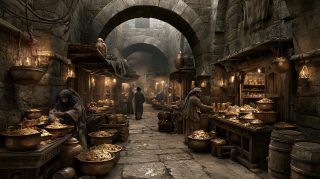
The Marketplace is much more than a place where players buy and sell items. It is the economic network that connects every city in the game. Instead of relying solely on your own production, you gain access to the work of thousands of other players. Likewise, everything your city produces can become useful to someone else. This continuous exchange creates a living economy where every participant contributes to the success of others.
One of the biggest misconceptions among new players is that they should try to produce everything themselves. While becoming completely self-sufficient sounds appealing, it is rarely the most efficient strategy. Every new production chain requires land, workers, buildings, maintenance, and investment. Expanding into every industry too early often slows your progress rather than accelerating it.
The Marketplace offers a smarter solution.
Rather than producing every resource, you can specialize in the industries that best suit your city's development. If your forests produce abundant timber, focus on wood products and purchase the materials needed for industries you have not yet developed. Another player may have invested heavily in mining and can supply the metal your factories require. Someone else may specialize in agriculture and sell food at competitive prices.
Instead of competing in every industry, cities naturally support one another through trade.
This specialization creates a stronger economy for everyone. Players concentrate on what they do best while relying on the Marketplace to obtain everything else. As a result, cities expand more quickly, warehouses remain balanced, and production continues without unnecessary interruptions.
Understanding that the Marketplace is entirely driven by players is equally important. Nothing appears there automatically. Every listing represents a real player who decided to sell part of their inventory. Likewise, every purchase you make supports another city's economy.
Because of this, prices constantly evolve.
If many players harvest large amounts of grain, grain prices may decrease because supply exceeds demand. If numerous cities suddenly require iron for construction, iron prices may rise until additional miners increase production. These price movements are a natural consequence of player activity rather than predetermined game mechanics.
For beginners, this may seem unpredictable, but there is no need to become an economist. Simple observation is enough. After a few days of trading, you will naturally recognize which products tend to be inexpensive, which are consistently valuable, and which experience occasional price fluctuations.
The Marketplace is organized into four major trading areas, making navigation straightforward.
The first area contains raw materials. These resources include wood, stone, clay, agricultural products, grain, metals, and gold ore. They represent the starting point of almost every production chain. Since industries constantly consume these materials, they are among the most frequently traded goods in the game.
The second area contains consumer goods. These products have already passed through one or more production stages and are intended for your population. Food, beverages, clothing, tobacco, and jewelry all belong in this category. As cities become larger and more prosperous, demand for these finished goods continues to grow.
The third area focuses on workers. Labor is essential for operating businesses, and cities often experience changing workforce requirements. Buying additional workers can accelerate expansion, while selling excess workers allows players to adapt to new economic priorities.
The fourth area is dedicated to shares. Unlike physical goods, shares represent financial assets that can be traded using GOLD. They introduce another dimension to the economy by allowing players to invest beyond traditional production and commerce.
Although these sections contain different types of assets, they all follow the same basic process. You choose an item, review the available offers, compare prices, and complete a transaction. Whether you are buying timber, hiring workers, or investing in shares, the trading process remains familiar and easy to understand.
Successful trading is not about making complicated decisions. Instead, it is about developing good habits.
Always compare several offers before buying. The cheapest listing is not always the best choice, but reviewing multiple prices helps you understand the current market. Similarly, before selling, examine existing offers to avoid pricing your goods too high or too low.
Patience is another valuable quality. Prices fluctuate throughout the day as players create new listings and complete purchases. If you are not in a hurry, waiting for a better opportunity may save money or increase your profits.
At the same time, remember that keeping your factories operating is usually more important than saving a tiny amount of money. A slightly more expensive resource may still be worthwhile if it prevents production from stopping.
Another common mistake is treating the Marketplace as a last resort. In reality, experienced players interact with it constantly. Even large industrial cities regularly buy resources that they could theoretically produce themselves because purchasing them is sometimes faster, cheaper, or more profitable than expanding another production chain.
This flexibility allows players to react quickly to changing circumstances. Unexpected shortages become minor inconveniences instead of major obstacles. Surplus production becomes an opportunity to earn additional income instead of creating storage problems.
Every purchase made through the Marketplace is delivered directly to your city's shared warehouse. There is no need to organize transportation or assign delivery vehicles. As soon as the transaction is completed, the purchased goods become available for your industries to use.
Likewise, products created by your own businesses are stored in the same warehouse. This centralized inventory makes city management much simpler because every building draws resources from the same location. Whether an item was produced locally or purchased from another player, it is treated exactly the same by your production system.
As your city expands, the Marketplace gradually becomes more than a convenient trading platform. It becomes a source of information. Price movements reveal which industries are growing. Product shortages indicate rising demand. Oversupplied markets suggest increasing competition. Players who pay attention to these signals can make better investment decisions and identify profitable opportunities before others.
However, success does not require perfect predictions. Most prosperous cities achieve their wealth through consistent, sensible trading rather than risky speculation. Buying the resources you genuinely need, selling products you no longer require, and investing your profits back into production creates steady, reliable growth over time.
Eventually, you will notice that the Marketplace no longer feels like a separate feature of the game. It becomes an extension of your city's economy. Production and trade work together continuously, each supporting the other. Your industries create value, your trades generate income, and your investments finance the next stage of expansion.
Every thriving city follows this cycle. Resources become products. Products become profits. Profits become new opportunities. The Marketplace keeps this cycle moving by connecting every player into a shared economy where cooperation and competition exist side by side.
Mastering the Marketplace is therefore not about becoming the richest trader overnight. It is about learning how to use trade as a tool that strengthens every part of your city. Once you understand that principle, every transaction becomes another step toward building a larger, stronger, and more prosperous economic empire.
ding with Confidence: How the Marketplace Helps Your City Grow